Automotive Moments: Ultimate 101 Guide On Starter Motor & Alternator

As an overthinker, I’ve had lots of self-questioning automotive moments. Those moments didn’t only contribute to my trauma—they also gave me answers that I cannot even speak about during a normal conversation.
Call me crazy, but your crush calling you kinda stupid should be a serious offense.
I liked someone that once started asking me car related questions in a drunken state. I was new to the job and didn’t know much. One of the cars at the workshop had the hood open, and I remember him asking what one of the car parts was.
Both clueless and nervous, I said Starter Motor—it was indeed not a starter motor, but rather an Alternator. I’ll defend myself by saying that the two are similar—sue me, babe!
This person then went on to call one of my co-workers and she got it correct. I wanted the ground to swallow me whole because why embarrass me like that, man.
That moment hurt me and truthfully, I just folded my arms and walked away. And although mama raised a quieter, that isn’t a characteristic I want associated with my name.
I remember rushing home with my mind stuck on the two objects. I went on to do my research on the two, and what I found made me “Oh…,” under my breath. Sounds like a moan, but trust that it was far from that.
Now, because I’m a sweetheart that doesn’t want you to pass through the same hassle with your crush – below is a summary of my research that differentiates the Starter Motor from an Alternator.
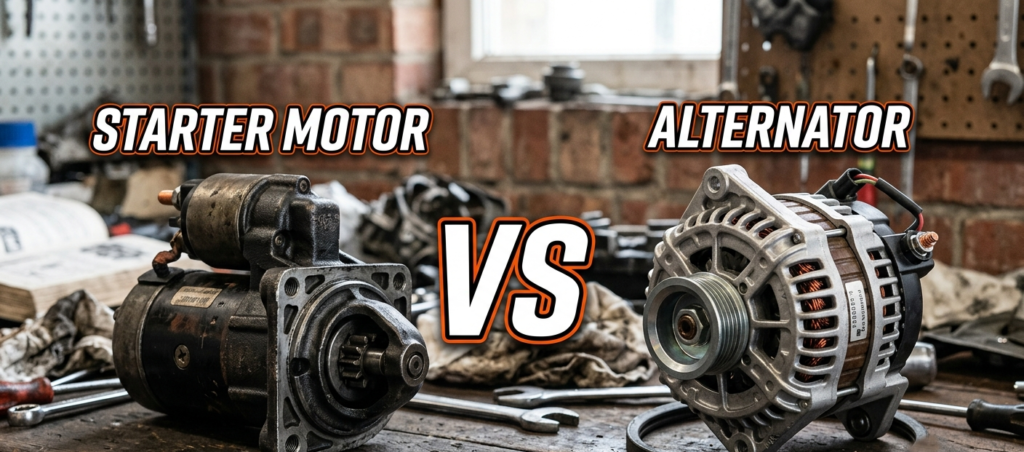
The Starter Motor: The Igniter
The starter motor is the “get-up-and-go” component. Its main purpose is to get the engine running. Think of it as the power button on your phone: you press it and wait for the device to turn on. It is the same principle here.
How it works: When you turn the key or press the “Start” button, high-voltage electricity is sent from the car’s battery to the starter motor. The starter then uses that power to physically crank the engine, turning the crankshaft to begin the combustion process. Basically, the electricity “shocks” the engine before turning the crankshaft, triggering the combustion process.
When it runs: This operation takes only a few seconds—strictly during the start-up phase.
What happens if it fails: If your starter motor fails to operate, you’ll hear a clicking sound or nothing at all. This might mean it is completely dead, or the brushes within it are worn out and in need of replacement. Mind you, this might happen even with a fully charged battery.
The Alternator: The Power Point
The starter motor’s job is dismissed immediately once the engine is running; now, it is the alternator’s time to shine. This component is what prevents your engine from shutting down. It is the heart of your car’s electrical system.
How it works: The alternator is the generator of your car. As the engine runs, a drive belt spins the alternator, converting mechanical energy into electricity.
When it runs: As long as your engine is on, the alternator operates continuously.
What it does: It has two jobs: to power the car and to recharge the battery. It provides electricity for all electronics—headlights, radio, air conditioning, wipers, and anything else that uses power. It also tops up the energy depleted from your battery during the starter motor’s startup phase.
What happens when it dies: If the alternator fails while you are driving, the car will use the remaining energy from your battery until it is completely depleted. Before this happens, you will notice your headlights dimming, warning lights flashing on your dashboard, and eventually, the engine will shut off and the car will come to a halt.
How to Tell Which is the Problem
We often assume one is the problem when it is actually the other. Here is how to tell the difference:
- If your car won’t start: It is likely the starter motor or the battery that has issues.
- If your car dies while you’re driving, or won’t restart after turning it off: It is likely your alternator that is the culprit.
In conclusion, the two work hand-in-hand. One cannot work without the other. It is important to pay close attention to these two systems early in the morning or whenever you are operating your car.
Paying close attention to these objects might protect not only your life but the lives of others on the road. Be conscious of your vehicle when using the road.
Remember: your car will always tell you when it is in need of care—you just have to listen to it. And always make sure to consult with a qualified electrician or mechanic before working on either of these components.