
Starter Motor, Alternator, Battery: The Ultimate Electrical Car Threesome 101
Having self-doubt as an overthinker is a primary 101 requirement. You’ll be driving down the road with your head in the clouds; I missed a green light last week because of this.
As both a mechanic and driver, I’ve had several confusing moments of whether or not I was doing shit right. There have been instances in which I had to do thorough research on a topic because of both doubt and lack of knowledge. And one of those moments was when a crush I had kind of indirectly called me stupid.
This person was drunk, so I really don’t blame him. I laugh when I remember that moment.
I was new to the job. I didn’t have one single clue of what I was doing, nor did I even know shit on anything. I knew the basics such as engine oil, spark plugs, and the likes—I was still a teen. A damn kid, y’all.
This man looked at me with drunken, sunken eyes, and my dumbass was blushing. Like fuck me. Not literally, though.
So, this man asked me what a certain car part was, and I replied by saying the starter motor—it was, indeed, not a starter motor but rather an alternator. It was confirmed by a former colleague of mine.
In my defense, I never went to any college or university for this. She did. I was as clueless as a motherfucker.
So, my mother raised a quitter. However, quitting doesn’t really take you anywhere.
Immediately I got home, I began my research. I asked those I could on this topic, and they helped the best they could. I was eager to learn. And you being here means that you are too—if not, that’s a bloody lie.
The Main 101 Difference Between a Starter Motor, an Alternator, and a Battery
This is a long topic: buckle up and enjoy the ride. If I get anything wrong at any point, be free to inform me. If you’re arrogant with your knowledge, I’ll fight you. Whether you’re right or wrong.
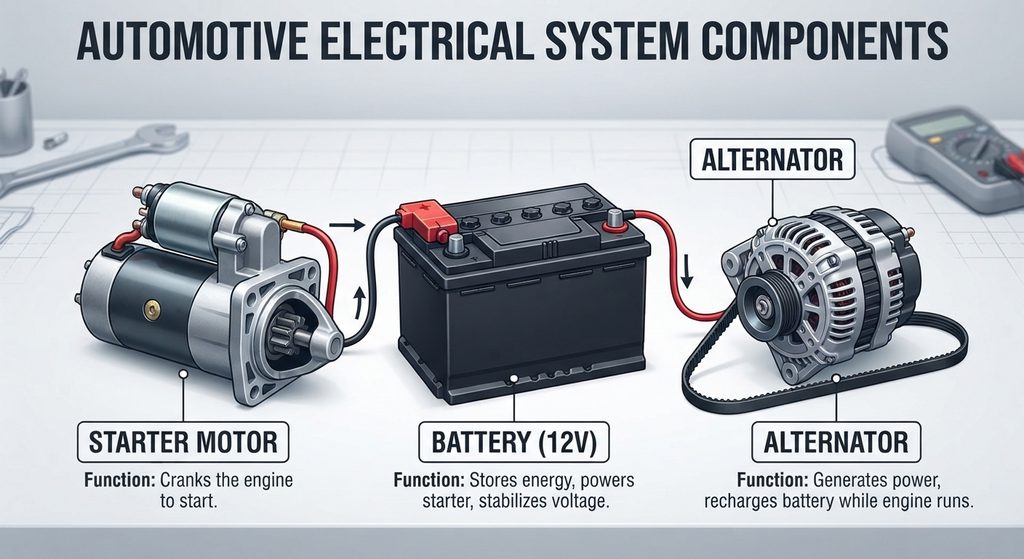
Starter Motor: The Igniter
This is the “get-up-and-go” component of your vehicle. The main purpose of the starter motor is to get the engine running.
How It Works: Have you ever thought of what goes on when you turn your phone on? How things get to work—well, this process is somehow similar.
When you turn the key in the ignition or press on the “Start” button, high-voltage electricity is sent from your car’s battery to the starter motor. The power is then used to physically crank the engine, turning the crankshaft, thus beginning the combustion process.
In simpler terms, the electricity “shocks” the engine, which turns the crankshaft. This trigger begins the combustion process.
When It Runs: This operation takes only a few seconds, strictly during the start-up process.
What Happens If It Fails: A clicking sound might be heard, or even nothing at all. You’ll be trying to operate your vehicle, but it won’t fully engage.
Let’s go back to the phone: you press your phone, and it seems to turn on, right? Well, as you’re waiting for it, it suddenly goes off. You know it’s working, but it won’t turn on. Same thing here.
The starter motor is made up of different items: check with an electrical mechanic to see if the things within the starter are worn out, or if the starter itself is in need of replacing.
Alternator: The Power Point
The starter motor’s job is dismissed immediately the alternator gets into action. This item prevents your engine from shutting down. It would be considered the heart of a car’s electrical system.
How It Works: This is more or less the generator of your car. As the accessory belt spins the alternator, mechanical energy is then converted into electricity which is used.
When It Runs: For as long as your engine runs, the alternator will be in operation.
What It Does: The alternator has two jobs:
1.) To power your car and recharge your battery. It also provides electricity for all electronics; namely, headlights, wipers, and anything in requirement with electrical energy.
2.) It also replaces the energy extracted from the battery during the starter motor’s startup phase.
What Happens When It Dies: From experience, I’d tell you to be wary of discontinued electrical support. That includes your headlights dimming and your dashboard coming alive in a faint type of way.
The crazy thing about this item is that it can make your car come to a complete halt whilst you’re driving. Be very alert.
Battery: The Silent Middle-Man
The battery works with both the starter motor and alternator. It assists the starter motor during the start-up process and also works hand-in-hand with the alternator to keep your engine running.
How It Works: Automotive batteries are lead-acid cells. Inside the plastic casing, the lead plates are submerged into a liquid or gel solution containing sulfuric acid and electrolyte (water).
Discharge and Recharge: Battery discharge happens when a chemical reaction between lead plates and acid releases electrons, thus converting chemical energy into electrical energy. This energy cranks up the engine. This is more related to the starter motor.
Recharge happens when the engine runs. The alternator forces current back through the battery in reverse, converting electrical energy into chemical energy.
What the Battery Does: It supplies a steady electrical current across the vehicle’s wiring system. It also acts as a stronghold for the electrical connection.
The battery feeds the starter motor and ignition system during startup. It powers the electrical system when the engine is off, and that includes the likes of the clock, radio, security alarm, and whatnot.
It also holds onto voltage spikes from the alternator, keeping sensitive onboard computers safe.
How to Know When It Dies: The battery will give you a few unmissable warnings before it finally calls it quits.
The car might have slow cranking, clicking sounds without any progress during the startup process, electrical glitches, and also the battery warning light might make its presence known. There might even be complete silence when you try to turn your car on.
How to Tell Which One Is the Problem
We often assume one is the problem when it’s actually the other. Here’s how you’d tell the difference:
- If your car won’t start, it’s likely the starter motor or battery that has issues.
- If your car dies when you’re on the road or won’t start after turning it off, it’s likely the alternator that’s at fault.
Final Verdict
These items work in union. One wouldn’t survive without the other. It is important to pay attention to these items early in the morning or before you operate your car.
Paying attention to these items will keep not only you safe, but others as well. Be conscious of your vehicle before and when you’re on the road.
Remember, your vehicle will always tell you when it’s in need of help. You just have to listen to it.
Now, tell me… have any of these items ever failed you?